CALL UOUsj#11 / UNSCRIPTED GROUNDS
Dear UOU participants,
It is a great pleasure for us to announce that our UOUsj has just been classified as Classe A by ANVUR, the Italian National Agency for the Evaluation of Universities and Research Institutes.
And what better way to celebrate this achievement than by announcing the Call for Papers for our next issue, UOUsj #11!
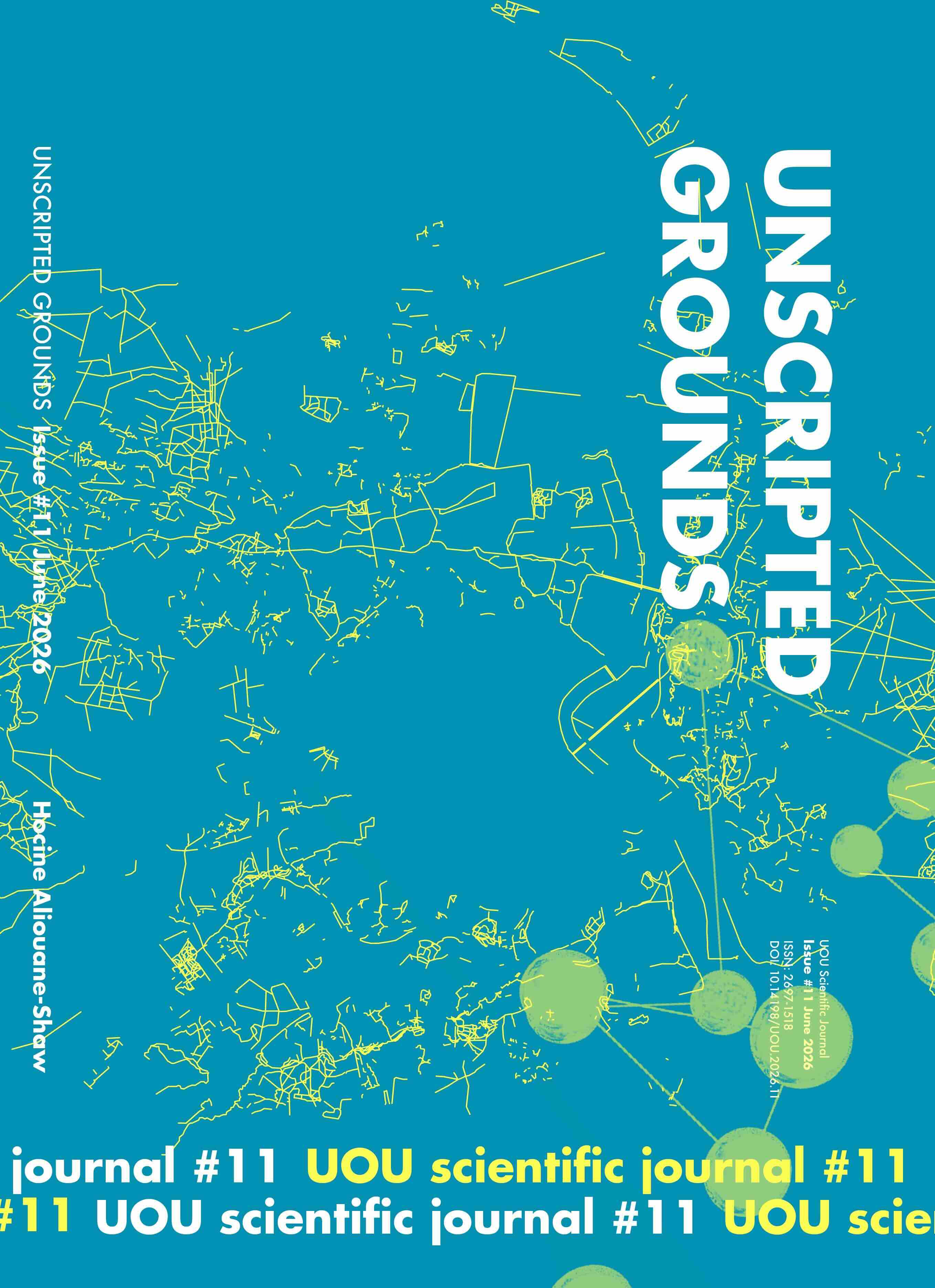
UOU scientific journal
Issue #11 / UNSCRIPTED GROUNDS
June 2026
Guest Editor: Hocine Aliouane-Shaw / ENSAP Bordeaux (France)
15 December 2025 – 5pm CET
Call opens.
WEBEX LINK:
https://ua2.webex.com/ua2/j.php?MTID=mde168ca7bab1a0068c63bcb4880122ba
Meeting number: 2742 838 4503
Password: qHDeh9mn9B4
15 February 2026
Full paper submission.
15 March 2026
Outcome of double-blind peer review process.
15 April
Final submission of completed papers.
Call for Papers – UOU Scientific Journal #11
UNSCRIPTED GROUNDS
(Situations, Practices and Shared Stewardship at the Margins of City-Making)
This issue explores unscripted grounds: environments left open, undefined or held in suspension that often occupy blind spots in conventional architectural practice and spatial planning. These are spaces of various scales that have slipped out of formal and institutional control. Rather than disappearing altogether, they remain hidden in plain sight; and as former functions wane, informal and unforeseen ones begin to emerge. Drawing on Ignasi de Solà-Morales’s notion of the “terrain vague” and related debates on liminality, in-between conditions and vacancy, unscripted grounds also refer to places where scripts of ownership, use and value are loosened and not yet stabilised.
Far from empty in terms of ecological life or informal uses, these grounds often concentrate, among other things, the layered histories of obsolete industrial or transport infrastructures, redundant buildings and compounds, residual spaces at the edges of housing developments, or peri-urban belts caught between former farmland and urban sprawl. What may read from the outside as voids in the urban fabric can, when seen from within, host dense entanglements of material traces of former uses, ecological processes, everyday tactics of inhabitation and, at times, informal economies. In this sense, unscripted grounds may be approached as situations rather than merely as sites: knots of material, social and symbolic relations that become legible through attentive, often collective forms of engagement with place.
Beyond treating these environments as the unaddressed underside of spatial planning, this issue asks how such grounds can be approached as situations where new ways of acting and living together may be rehearsed – and learned from – in order to inform more transversal and bottom-up approaches to architectural practice and urban planning. It seeks to explore how these environments can become grounds for experiments in situated care and shared learning, with varying degrees of commoning, whilst remaining attentive to how such actions intersect with and resist longer-term dynamics of “normalization” and, in some cases, gentrification. The issue is thus also concerned with how unscripted grounds shift over time – whether they remain at the margins or are reintegrated into mainstream planning, and to what extent lessons from on-the-ground experimentation persist or are erased in the process.
We invite contributions that draw on grounded engagement with uncertain contexts and combine empirical knowledge with critical reflection, in an attempt to reimagine architectural and urban practices from the ground up. We are particularly interested in contributions that treat these engagements as forms of inquiry – whether research, pedagogy or practice – and that reflect explicitly on their methods, positionalities and, where relevant, the ethical questions raised by participatory, collaborative and co-produced approaches.
We are particularly keen on work that:
- offers thick, situated accounts of specific situations and practices, tracing how pre-existing material and immaterial conditions are mobilized to open possibilities for new uses, forms of prefiguration and, where relevant, longer-term transformations;
- makes explicit the power relations, legal frameworks and property regimes that underpin access, vacancy and temporary use, and examines how these can either lock places into prolonged “in-betweenness” or open room for more transversal forms of governance and ownership;
- traces how unscripted grounds may become sites of ecological repair, social experimentation or shared stewardship, asking under which conditions such practices emerge, persist and circulate as situated forms of knowledge;
- critically examines how the emancipatory potential of “temporary uses” and “transitional urbanism” can be preserved from being instrumentalised as a pretext for land valorisation and “normalisation”, and what strategies help resist or redirect these dynamics.
Possible, but not exclusive, points of entry include:
- Countering obsolescence through reinvention and prefiguration
What remains active when infrastructures, industrial artefacts, military or institutional complexes fall out of use and their original functions have faded? How do material traces, spontaneous ecological succession and informal or experimental uses keep these grounds stubbornly present in the life of a territory, opening up fields of possibility for experimentation, prefiguration or longer-term reinvention?
- Engaging unscripted grounds through performative and situated practices
How do walks, situated mappings, artistic actions, pedagogical studios or community-led events engage unscripted grounds as spaces of learning and experimentation? What kinds of embodied and shared knowledge emerge from such practices, and how might these travel into more conventional planning and design frameworks, or contribute to reshaping them?
- Implementing dynamics of care through commoning, governance and shared responsibility
How can unscripted grounds begin to function as shared resources or commons rather than mere “sleeping opportunity sites”? Through what forms of governance, negotiation and practices of care can such dynamics be invented and tested on site? What questions shape these processes, and what kinds of emancipatory potential – as well as frictions or conflicts – do they reveal?
- Structuring territorial networks
How can unscripted grounds operate not only as isolated environments, but as parts of larger territorial configurations such as ring roads, ecological corridors, metropolitan edges or archipelagos of “leftover” land? What happens when walking paths or constellations of small interventions begin to connect these places into networks that reorient how territories are perceived, inhabited and, eventually, planned?
- Building situated narratives and critical imaginaries
How are unscripted grounds narrated, represented or silenced in public debate, planning documents, cinema, literature or activism? How can situated stories and counter-narratives contribute to reworking these imaginaries from an architectural and urban perspective?
We invite:
- Research articles and essays that develop critical, theoretical or historical arguments anchored in specific cases or comparative studies.
- Practice-based reflections by architects, collectives, artists, activists and local initiatives working directly with unscripted grounds, and wishing to articulate their approaches, tools and insights.
- Pedagogical experiments that use unscripted grounds as laboratories for teaching, including studios, workshops and other forms of situated learning.
- Visual essays and cartographies that use drawing, photography, mapping or other visual means as primary modes of inquiry, accompanied by a concise written commentary.
All contributions will undergo a double-blind peer review process (with adapted procedures for visual essays and student-related material). Selected papers will be published in open access on the UOU scientific journal platform. Detailed instructions on formats, length, templates and submission procedures are available on the journal’s website.
UOUsj is the scientific peer-reviewed journal of UNIVERSITY of Universities and investigates the sharing of intercultural interests explored in international architecture schools in close connection with the arts. Every issue underlines a specific topic addressed by one of the universities involved in the Research Project.
Therefore, we encourage contributions related to the result of pedagogical experiences and contributions that have emerged from research that engages with the topic underlined by the call in the disciplines of architectural design, urbanism and environmental studies, art, and associated areas of study.
Guest Editor:
- Hocine Aliouane-Shaw, ENSAP Bordeaux (France)
Associate Editors:
- Joaquín Alvado Bañón, Alicante University (Spain)
- Michael Devereux, University of the West of England Bristol (UK)
- Angela Kyriacou Petrou, University of Nicosia (Cyprus)
- Paola Scala, Università di Napoli Federico II (Italy)
Managing Editor
- Maria Luna Nobile, Umeå University (Sweden)
Editor-in-Chief
- Javier Sánchez Merina, Alicante University (Spain)
SUBMISSION GUIDELINES:
https://revistes.ua.es/uou/author-guidelines
PEER REVIEW PROCESS:
https://revistes.ua.es/uou/peer-review-process
INDEXINGS
Multidisciplinary databases
Specialized databases
Evaluation resources
- Latindex
- ERIH PLUS
- Agenzia Nazionale di Valutazione del Sistema Universitario e della Ricerca (ANVUR), Italia – CLASSE A
- NORWEGIAN REGISTER FOR SCIENTIFIC JOURNALS, SERIES AND PUBLISHERS
- Sherpa Romeo
Other quality indicators
- Google Scholar
- Matriz de Información para el Análisis de Revistas (MIAR)
- Repositorio Institucional de la Universidad de Alicante (RUA)
- Redalyc
- WorldCat
For any information, you can contact the Guest Editor, Hocine Aliouane-Shaw, at: