
CALL UOUsj#13 / THE CITY OF TREES
Dear UOU Enthusiasts,
We are delighted to announce what we believe is a truly necessary theme for our next issue:
THE CITY OF TREES, and its Call for Papers!
We are looking forward to exploring, together, the multiple ways in which trees can transform our understanding of the city, architecture, landscape, and the ways we inhabit our shared environment.
Thank you all for being part of this journey, and for continuing to make UOU a space for exchanging ideas, experiences, and knowledge across borders.
Let’s make the city grow!
The UOU Team
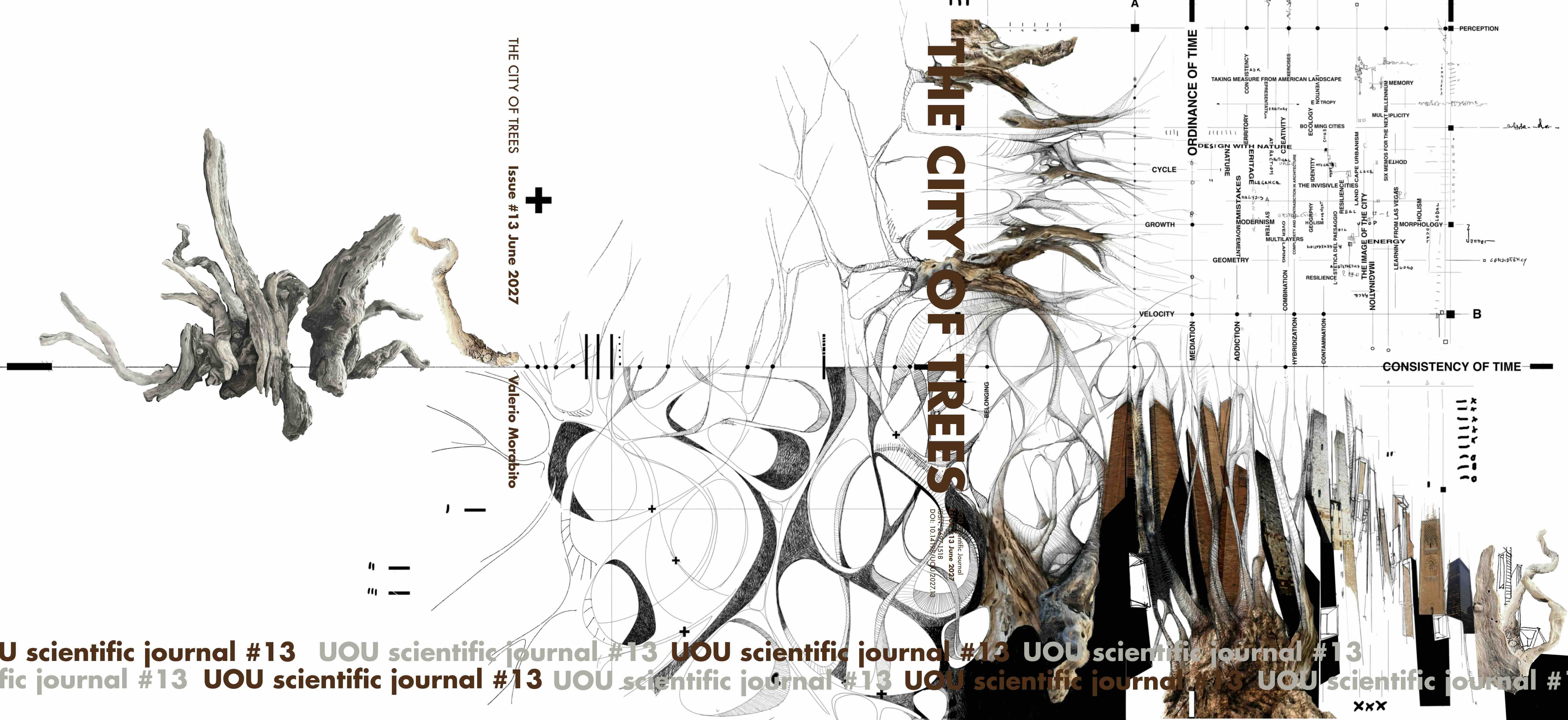
UOU scientific journal - Issue #13 / THE CITY OF TREES
June 2027
Guest Editor: Valerio Morabito, Università Mediterranea Reggio Calabria. Italy.
15 September 2026, 5pm CET / Call opens:
https://vertice.cpd.ua.es/319811
WEBEX LINK
https://ua2.webex.com/ua2/j.php?MTID=m4fd26be80a20d7b5b60f3dec3168d77e
Meeting number: 2743 796 5841
Password: YjryMpdq868
15 January 2027 / Full paper submission
15 February 2027 / Outcome of double-blind peer review process
15 May 2027 / Final submission of completed papers
THE CITY OF TREES
Trees as Urban Co-Designers
Post-Anthropocentric Perspectives on the Future of Cities
Thematic Focus
Trees have generally entered urban discourse as environmental infrastructure, aesthetic components, or providers of ecosystem services. They offer shade, reduce urban heat, absorb carbon dioxide, retain water, support biodiversity, and improve the quality of public space. Although essential, these descriptions continue to define trees principally through their usefulness to humans.
This issue proposes a different starting point: trees are not passive objects placed within cities but living subjects that actively participate in their spatial, ecological, and temporal transformation.
Trees occupy, modify, and redesign urban space. Their roots fracture and reshape the ground; their trunks establish distances and orientations; their canopies construct shade, shelter, atmosphere, and changing boundaries. Through growth, adaptation, decay, and regeneration, they continuously revise the places they inhabit. They respond to climate, soil, water, other species, built structures, and human behaviour. Their forms are not fixed compositions but evolving spatial decisions.
From this perspective, trees may be understood as intelligent urban co-designers. Their intelligence does not necessarily resemble human reasoning or intentionality. It emerges through sensitivity, memory, adaptation, cooperation, improvisation, and the ability to negotiate changing environmental conditions. Trees design through their bodies and through time.
Such an assumption requires us to reconsider the conventional distinction between the human designer and the non-human object of design. What happens when the tree is no longer treated as material within a project, but as an autonomous presence capable of modifying that project? Can urban design become a process of negotiation between different forms of intelligence, agency, and duration?
Trees also possess temporalities that exceed those of political mandates, construction programmes, and human lives. They may survive the intentions that led to their planting, transform the spaces conceived around them, and give gardens, streets, ruins, and abandoned places unexpected afterlives. Some trees grow within carefully planned conditions; others emerge in residual, hostile, or forgotten spaces. In both situations, their actions reveal forms of resilience, intuition, and spatial invention that challenge the apparent stability of the city.
A post-anthropocentric perspective therefore asks us to move beyond the idea of simply designing for trees. It invites us to consider how cities might be designed with trees—and, more radically, how trees already design cities themselves.
This issue of UOUsj welcomes theoretical, critical, visual, and interdisciplinary contributions exploring trees as active participants in the production, transformation, and imagination of urban environments. Contributions may engage with architecture, landscape architecture, urban design, ecology, philosophy, environmental humanities, political ecology, art, geography, and multispecies studies.
Possible Perspectives
Contributions may address, but are not limited to:
- trees as intelligent agents of urban spatial production;
- trees as designers rather than elements of design;
- vegetal intelligence, memory, sensitivity, and communication;
- arboreal form, posture, movement, and spatial expression;
- trees that adapt to, resist, or transform architectural structures;
- spontaneous trees in ruins, residual spaces, and abandoned urban areas;
- post-anthropocentric and more-than-human approaches to city-making;
- arboreal temporality and long-term urban transformation;
- trees as political, social, ecological, and cultural actors;
- coexistence, co-design, and multispecies urban governance;
- vegetal networks as alternative forms of infrastructure;
- urban forests as models of collective organization and resilience;
- trees as witnesses to urban histories and human mistakes;
- the afterlives of gardens, landscapes, and designed spaces;
- ethical questions arising from designing with non-human beings;
- decolonial, ecological, and posthuman interpretations of urban vegetation;
- new forms of representation capable of expressing arboreal agency;
- artistic, architectural, and landscape practices that recognize trees as creative partners.
Theoretical Perspectives
Contributions may engage with posthumanism, post-anthropocentrism, plant philosophy, new materialism, actor-network theory, multispecies studies, environmental philosophy, landscape urbanism, political ecology, and related fields.
Particular attention will be given to contributions that question the ontological separation between human designers and non-human urban actors. The issue is not intended to prove that trees possess intelligence according to human categories. Instead, it begins from the assumption that trees manifest their own forms of intelligence and asks where, how, and through which spatial conditions this intelligence becomes perceptible.
Key Questions
What would a city become if trees were considered not as objects located within urban space, but as subjects participating in its design and evolution?
How might architecture and urban design respond to the agency, autonomy, and temporal depth of arboreal life?
What can designers learn by observing how trees occupy space, negotiate limits, construct relationships, and adapt to uncertainty?
Can the city be understood as a multispecies work in continuous transformation rather than as an exclusively human creation?
Toward a City Designed with Trees
This special issue seeks to advance a radical reconsideration of urban futures by positioning trees as co-creators of cities. It invites contributors to investigate forms of design that emerge through coexistence, reciprocal transformation, and dialogue between human and vegetal intelligence.
Rather than asking how trees can serve cities, this issue asks how cities might learn from trees.
Guest Editor:
- Valerio Morabito, Università Mediterranea Reggio Calabria (Italy)
Associate Editors:
- Maria Luna Nobile, Umeå University (Sweden)
- Michael Devereux, University of the West of England Bristol (UK)
- Sarah Stevens / University of Brighton, UK
Managing Editor
- Joaquín Alvado Bañón, Alicante University (Spain)
Editor-in-Chief
- Javier Sánchez Merina, Alicante University (Spain)
SUBMISSION GUIDELINES:
https://revistes.ua.es/uou/author-guidelines
PEER REVIEW PROCESS:
https://revistes.ua.es/uou/peer-review-process
INDEXINGS
Multidisciplinary databases
Specialized databases
Evaluation resources
- Agenzia Nazionale di Valutazione del Sistema Universitario e della Ricerca (ANVUR), Italia – CLASSE A
- Latindex
- ERIH PLUS
- NORWEGIAN REGISTER FOR SCIENTIFIC JOURNALS, SERIES AND PUBLISHERS
- Sherpa Romeo
Other quality indicators
- Google Scholar
- Matriz de Información para el Análisis de Revistas (MIAR)
- Repositorio Institucional de la Universidad de Alicante (RUA)
- Redalyc
- WorldCat
For any information, you can contact the Guest Editor, Valerio Morabito, at:
valerio.morabito@unirc.it