When the Groundwater Kicks Back
Re-Drawing of Architectural Detail
DOI:
https://doi.org/10.14198/UOU.2025.10.06Abstract
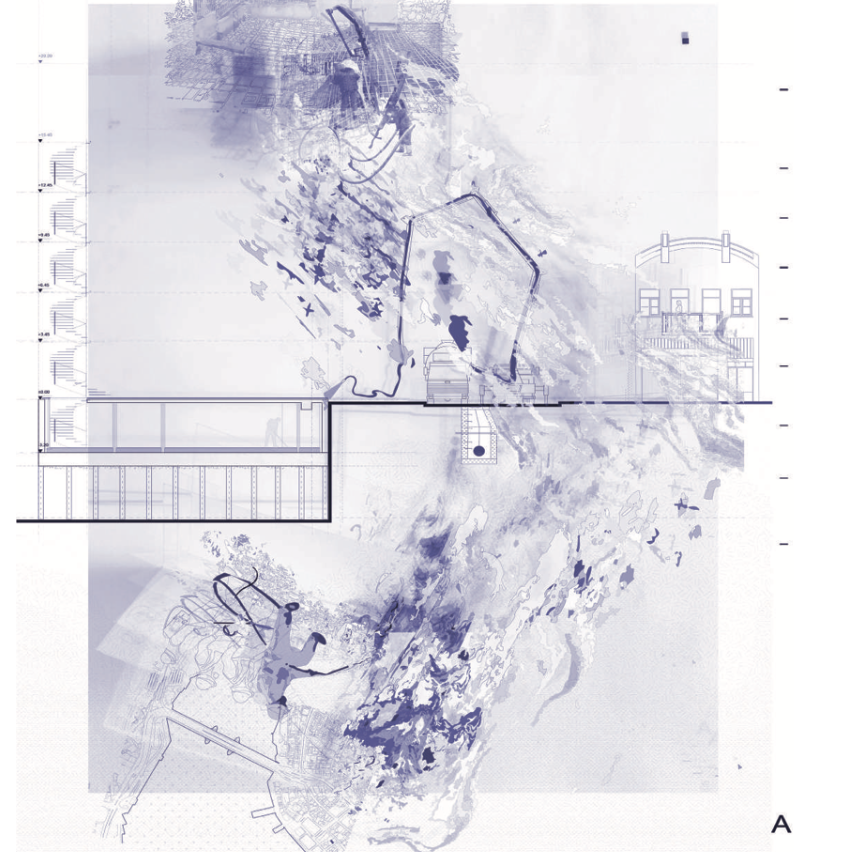
This study examines architectural detail as a powerful force that shapes the material-discursive practices of architecture. It reframes the detail through a feminist, new materialist, and post humanist perspective that integrates insights from environmental humanities. The research challenges the conventional view that technical drawings provide objective, finalized knowledge by interrogating assumptions of material objectivity. Instead, it argues that drawings and details generate relational, situated knowledge (Haraway, 1988) through entanglements of human and nonhuman agents. Grounded in the theoretical framework of agential realism (Barad, 2007), the work conceptualizes the architectural drawing as an apparatus that actively shapes reality and sets epistemological boundaries. Barad (2007:142) defines apparatuses as specific material reconfigurations that iteratively shape space-time-matter. In this sense, technical drawings are not a passive background but apparatuses that establish epistemological limits, determining what will matter and what will be excluded. The study proposes viewing detail as a material-discursive joint where materials, people, regulations, stories, and natural forces entangled. The discussion focuses on a construction case study in Istanbul’s Kadıköy district, where the divergence between the design-phase drawing of a foundation detail and its on-site implementation was traced through the development of non-human agents, mainly groundwater. Based on observations, interviews, and a (re)drawing of the detail, the research questions the “objective certainty” of technical drawings and demonstrates that detail functions as a relational performance shaped by human intentions, material flows, and environmental forces. Finally, this perspective offers an entry point into understanding the intertwining of architecture and more-than-human worlds.
Downloads
Downloads
Published
How to Cite
Issue
Section
License
Copyright (c) 2025 Mine Öztürk Dinçer

This work is licensed under a Creative Commons Attribution 4.0 International License.
The authors keep their rights upon their work, although they transfer, in a non-exclusive way, the rights of exploitation (reproduction, publication, distribution, public dissemination and presentation) to the Journal. The authors are, therefore, free to enter additional, separate contracts for the non-exclusive distribution of the version of the work published in the Journal (for instance, by hosting in an institutional repository or publication in a book), provided credit is given that the work was initially published in this journal. The works are published under a Creative Commons Attribution 4.0 (CC BY 4.0) license.