How to Draw a Ghost
A Lobotomy's Tale: Kowloon Walled City
DOI:
https://doi.org/10.14198/UOU.2025.10.09Abstract
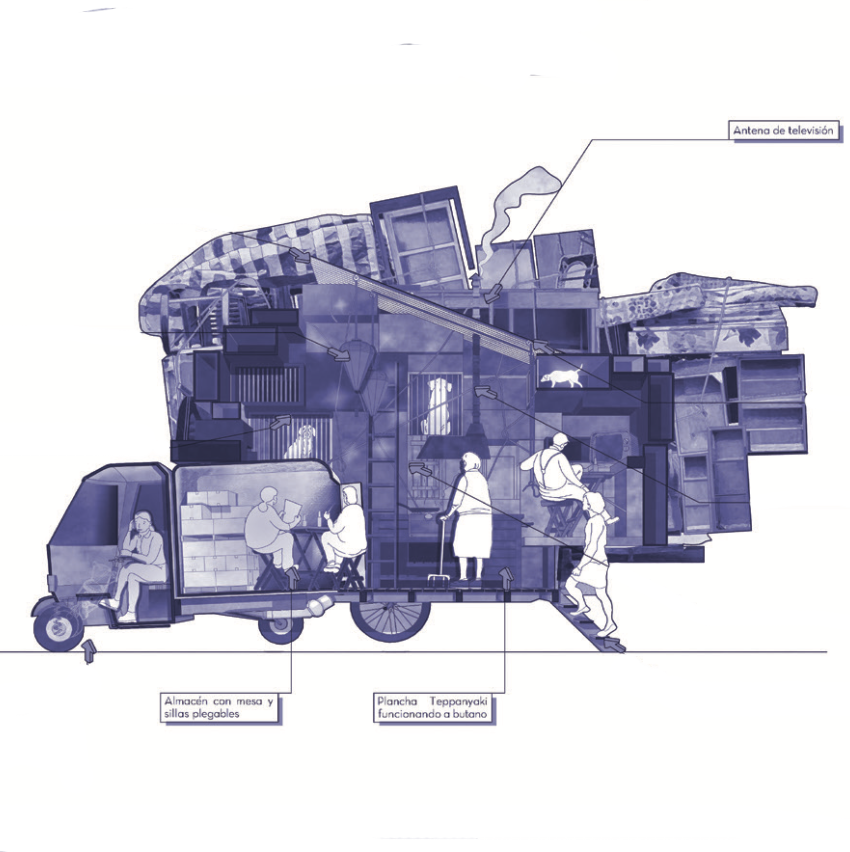
A Lobotomy’s Tale is a research project on the extinct walled city of Kowloon, once the most densely populated building in the world. Bizarre, ordinary, precarious… these are some of the qualities of this architecture that, in most academic discussions, have been omitted due to the perceived poor quality of its proposals.
With this project, we wanted to defend this architecture and its inhabitants as models of empowerment, participation, and dissidence, but also as an urban laboratory that revealed new ways of understanding the city’s complexity.
The project begins with the definition of its title: “A Lobotomy’s Tale.” We understand the term lobotomy as induced amnesia—the rewriting of history through the amputation of a dissenting body. Any historical event studied from the present implies accepting as valid a hegemonic discourse that is invariably political and based on some form of exclusion. Yet, there are always other suppressed possibilities that can be reactivated.
The study of Chris Ware’s work became one of the main pillars of this project. Building Stories, a comic book composed of a succession of different formats and dimensions, is characterized by having neither beginning nor end, where the reader is neither inside nor outside, but rather woven into the fabric of history. In an attempt to be consistent with this, the project is made up of videos, drawings, texts, a book…
This work is also a manifesto, positioning the final degree project as an exercise that must also respond to other realities of architectural practice that move away from building construction.
Downloads
Downloads
Published
How to Cite
Issue
Section
License
Copyright (c) 2025 DAVID JIMENEZ INIESTA, María de los Ángeles Peñalver Izaguirre

This work is licensed under a Creative Commons Attribution 4.0 International License.
The authors keep their rights upon their work, although they transfer, in a non-exclusive way, the rights of exploitation (reproduction, publication, distribution, public dissemination and presentation) to the Journal. The authors are, therefore, free to enter additional, separate contracts for the non-exclusive distribution of the version of the work published in the Journal (for instance, by hosting in an institutional repository or publication in a book), provided credit is given that the work was initially published in this journal. The works are published under a Creative Commons Attribution 4.0 (CC BY 4.0) license.