
The Disinherited Fitment
Detail as Political Witness
DOI:
https://doi.org/10.14198/UOU.2025.10.05Abstract
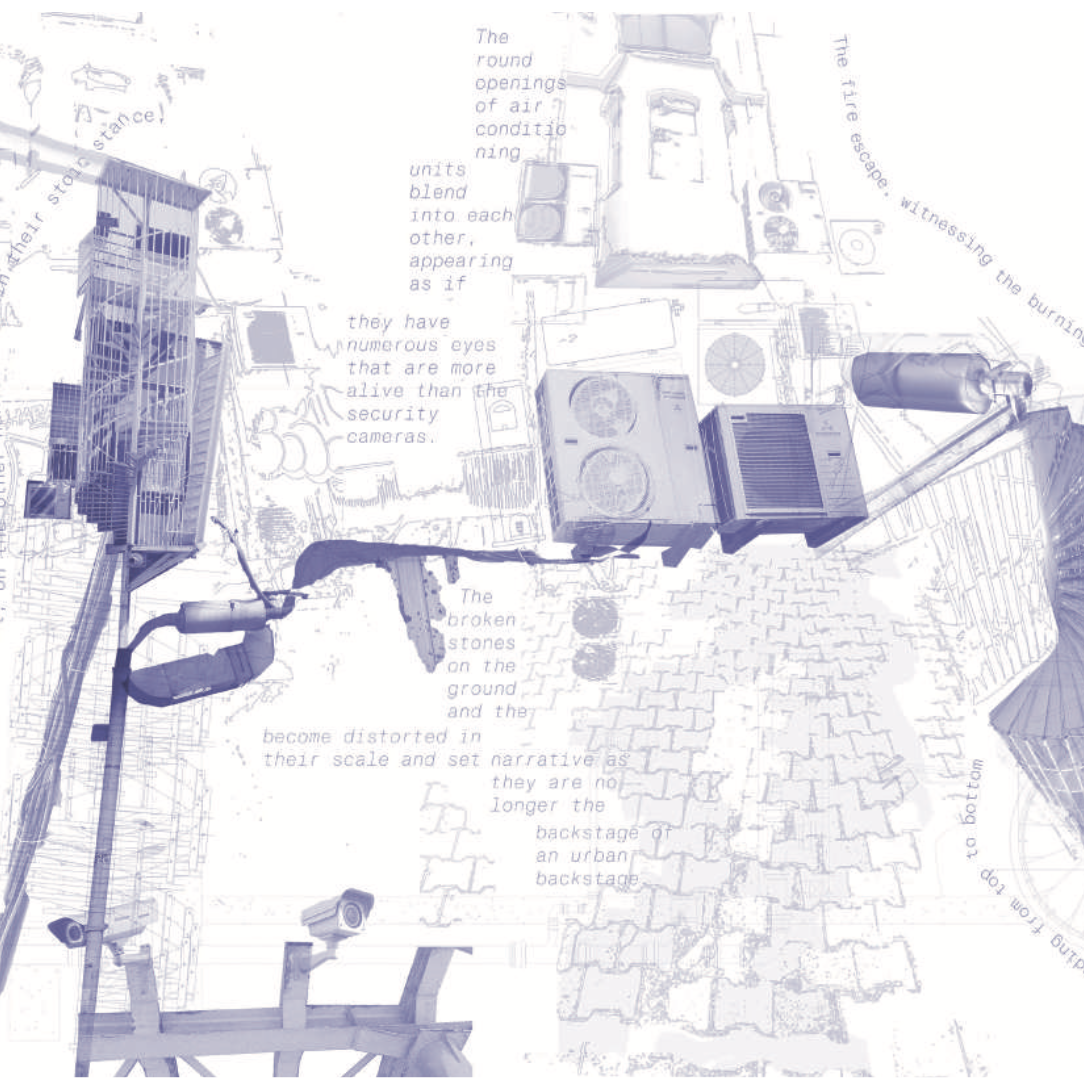
This article reframes architectural detail as a political witness, shifting attention from technical or aesthetic refinement to the overlooked fragments of Arslan Yatağı Street in Istanbul—an infrastructural alley where police violence abruptly disrupted the 20th Feminist Night March in 2022. Here, infrastructural fragments are recognized as details as they operate at the scale where systems meet bodies: pipes, air-conditioning units, manholes, paving stones, stains, and security cameras are the joints and terminations of larger networks that sustain the whole while remaining in the background. Through two speculative drawings under the title The Disinherited Fitment, these fragments are enlarged, layered, and distorted to operate as nonhuman witnesses rather than neutral spatial elements. Methodologically, the work couples an architectural ethnography with the protocol of be–linger–record–return, along with fiction and allegory, shifting drawing from depiction to interrogation. Drawing 1 crystallises the instant of rupture without reproducing spectacle; Drawing 2 works in the temporality of the event by tracing how residues thicken in the aftermath. The article argues that detail is a site where political and affective forces converge, that drawing can operate as a speculative ethnography capable of re-narrating a politically charged event, and that from the cramped conditions of Arslan Yatağı Street emerge forms of minor politics in which legitimacy is not granted but only briefly inhabited. Rather than documentation or design solution, the project offers a way of working with detail by staying close to what is marginal, allowing it to come forward, and recognising architecture’s critical potential in the realm of minor.
Downloads
Downloads
Published
How to Cite
Issue
Section
License
Copyright (c) 2025 Melike Beşik, Bihter Almaç

This work is licensed under a Creative Commons Attribution 4.0 International License.
The authors keep their rights upon their work, although they transfer, in a non-exclusive way, the rights of exploitation (reproduction, publication, distribution, public dissemination and presentation) to the Journal. The authors are, therefore, free to enter additional, separate contracts for the non-exclusive distribution of the version of the work published in the Journal (for instance, by hosting in an institutional repository or publication in a book), provided credit is given that the work was initially published in this journal. The works are published under a Creative Commons Attribution 4.0 (CC BY 4.0) license.