A Diffractive Drawing Experiment
Recording Material Agency
DOI:
https://doi.org/10.14198/UOU.2025.10.11Abstract
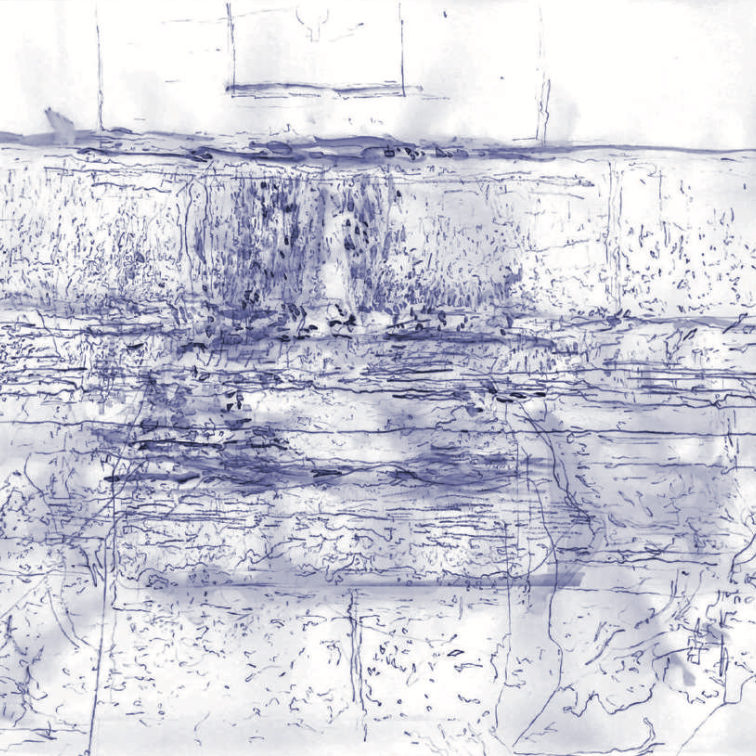
This paper aims to explore drawing as an act of recording to speculate a diffractive drawing, building on Karen Barad’s diffraction theory. I claim that the unpredictability of the diffractive drawing is a creative act that uses tracing/recording as a negotiating act between matter and the line. Therefore, the research of this paper focuses on several acts of recording. Through these drawing records, I aim to track the traces that are erased and maintained for the propriety of architecture.
The surface where architectural form and material body interact holds the micro-narratives of their entangled history. And for this study, I use indeterminacy as a tool to record these superimpositions of material’s past-present-futures. Through diffractive drawing, the record of material past is unraveled in its present, and the negotiating line between drafter and matter speculates on their future. There are three sets of records, each experiment with modes of indeterminacy: one through the gaze, one through the line, and one through the surface. Diffracted together, a space-time cartography of matter unfolds.
The site I chose for this study is a marble fountain, part of a historic monument in the historic peninsula of Istanbul. I speculate on the agency of the matter bound in architecture by the records of micro-narratives. I claim that architecture reveals a fragility that holds on to the record as straight lines that keep their propriety get broken and taken over by material emergence. Thus, the drawing becomes the archiving architectural body.
Downloads
Downloads
Published
How to Cite
Issue
Section
License
Copyright (c) 2025 Ayşe Hümeyra Yeşilyurt, Bihter

This work is licensed under a Creative Commons Attribution 4.0 International License.
The authors keep their rights upon their work, although they transfer, in a non-exclusive way, the rights of exploitation (reproduction, publication, distribution, public dissemination and presentation) to the Journal. The authors are, therefore, free to enter additional, separate contracts for the non-exclusive distribution of the version of the work published in the Journal (for instance, by hosting in an institutional repository or publication in a book), provided credit is given that the work was initially published in this journal. The works are published under a Creative Commons Attribution 4.0 (CC BY 4.0) license.