Unscripting from Within
The Human Void and Architectural Dissolution in São Pedro de Moel
DOI:
https://doi.org/10.14198/UOU.2026.11.11Abstract
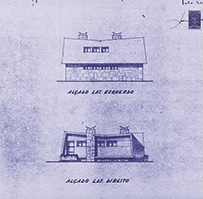
This essay examines the dissolution of modernist summer houses in São Pedro de Moel, a small coastal settlement on Portugal's central Atlantic seaboard, where between 1954 and 1974 a remarkable convergence of conditions produced the near-instantaneous normalisation of modern architecture. Drawing on building permits, field observation, and sustained inhabitation of the site, it argues that this dissolution is not primarily material but relational: what fails is not the architecture — which persists as legible structure — but the ecology of literacy, desire, and temporal alignment that once made the architecture legible and inhabitable. Inverting Solà-Morales's concept of *terrain vague*, the essay proposes that in São Pedro de Moel the territory remains scripted while the human subject has become unscripted — transparent to an architecture whose slow time no longer corresponds to the accelerated temporality of its contemporary inhabitants. The resulting pattern of systematic anti-repair — the consistent alteration of precisely those elements that already functioned — is read not as negligence but as a temporal violence imposed upon structures calibrated to age rather than to be replaced. The essay introduces the concept of *latent modernity* to explain the original reception of modernism, and develops *hermeneutic heteronymy* — a tripartite methodology of Investigator, Witness, and Narrator — as a structural response to an object of study that reveals itself to be not a building or a place but an event: the full arc from collective aspiration to material articulation to present dissolution.
Downloads
Downloads
Published
How to Cite
Issue
Section
License
Copyright (c) 2026 Joao Silveira Serejo

This work is licensed under a Creative Commons Attribution 4.0 International License.
The authors keep their rights upon their work, although they transfer, in a non-exclusive way, the rights of exploitation (reproduction, publication, distribution, public dissemination and presentation) to the Journal. The authors are, therefore, free to enter additional, separate contracts for the non-exclusive distribution of the version of the work published in the Journal (for instance, by hosting in an institutional repository or publication in a book), provided credit is given that the work was initially published in this journal. The works are published under a Creative Commons Attribution 4.0 (CC BY 4.0) license.