Notes from a Ground that Refuses to Resolve
Ambivalences of Participatory Practice in Rione Scala
DOI:
https://doi.org/10.14198/UOU.2026.11.05Abstract
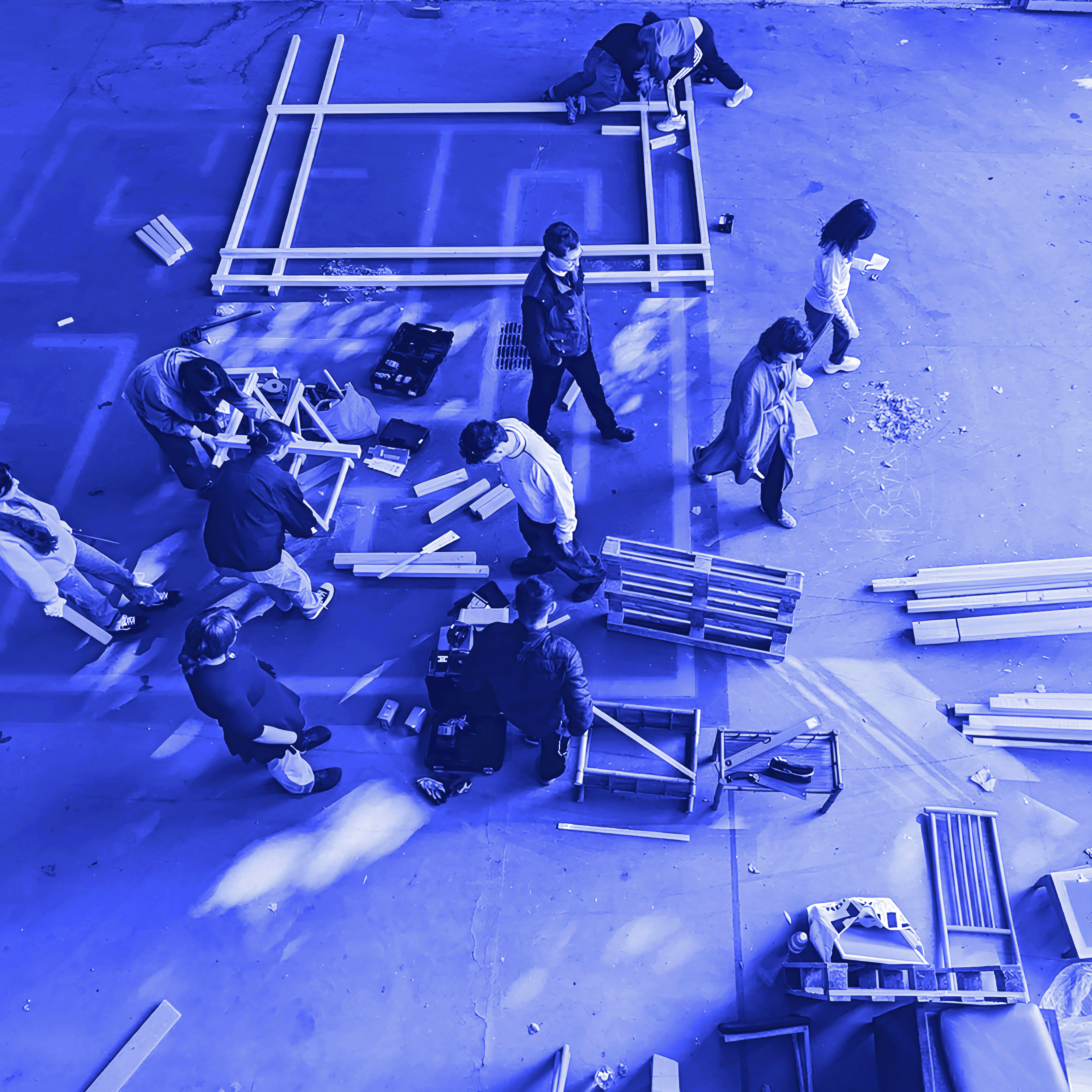
This article takes Rione Scala — a peripheral neighbourhood in Pavia, Italy — as the site of an ongoing inquiry into what it means to practise architecture in territories that resist resolution. Drawing on five years of engagement through Architectures of Care, it positions the neighbourhood as an unscripted ground: not a space of mere absence or neglect, but a situation in which the scripts of ownership, use, and institutional value are loosened, suspended, or contested. Following de Solà-Morales's notion of the terrain vague, I argue that this resistant indeterminacy is not a problem awaiting architectural solution but a condition from which architectural knowledge must be generated. The article proceeds through situated field notes, staging tensions between presence and extraction, institutional mediation and structural critique, the production of commons and the risk of their aestheticisation, with participatory action research (PAR) at its centre — examined for its emancipatory potentials and the risks it carries when practised from within an academic institution in a marginalised urban territory. Drawing on Haraway (1988), Tronto (1993), Puig de la Bellacasa (2017), Federici (2018), Rawes (2013), Heynen, Kaika, and Swyngedouw (2006), and Lefebvre (2004), I frame situated architectural research — a reflexive practice that refuses to resolve the contradictions it inhabits — and propose that the peripheral unscripted ground demands not an architecture of resolution, but one of sustained, accountable, and structurally conscious presence.
Downloads
Downloads
Published
How to Cite
Issue
Section
License
Copyright (c) 2026 Nadia Bertolino

This work is licensed under a Creative Commons Attribution 4.0 International License.
The authors keep their rights upon their work, although they transfer, in a non-exclusive way, the rights of exploitation (reproduction, publication, distribution, public dissemination and presentation) to the Journal. The authors are, therefore, free to enter additional, separate contracts for the non-exclusive distribution of the version of the work published in the Journal (for instance, by hosting in an institutional repository or publication in a book), provided credit is given that the work was initially published in this journal. The works are published under a Creative Commons Attribution 4.0 (CC BY 4.0) license.